
Global Benchmarking is good but localised benchmarks are better: Explori's benchmark expansion
 Ben Haley, Product Manager
Benchmarking event performance means knowing what good looks like. And what good looks like is not a single number. It varies by region, by audience, by market maturity, and by the commercial and strategic context the event operates in.
When booking an all inclusive holiday, you are constantly evaluating if the price you are looking at is a 'good deal'. And something I know all too well, is that feeling when the hotel listing that you've been looking at for weeks that meets all your criteria, and suddenly you see the red text on the hotel listing "one room left at this price". Then the fear kicks in, and your mind starts rapidly evaluating should I just book it as if I don't book this now I'm going to miss out on a cracking deal.
It is hard to validate if something is a good deal based on the listings price and a few photos of white sandy beaches, frozen cocktails and the international buffet (unless I see lobster).
A sensible starting point is what you paid last time. But it may ignore most of the context that decides whether it's actually a good deal: the time of year, how many nights, the facilities and what other comparable options in that location typically cost.
Benchmarking event performance works the same way.
Year-on-year gives you your own reference point. But if you want to know whether you're genuinely performing well in the market you operate in, you need context that reflects where your event actually competes.
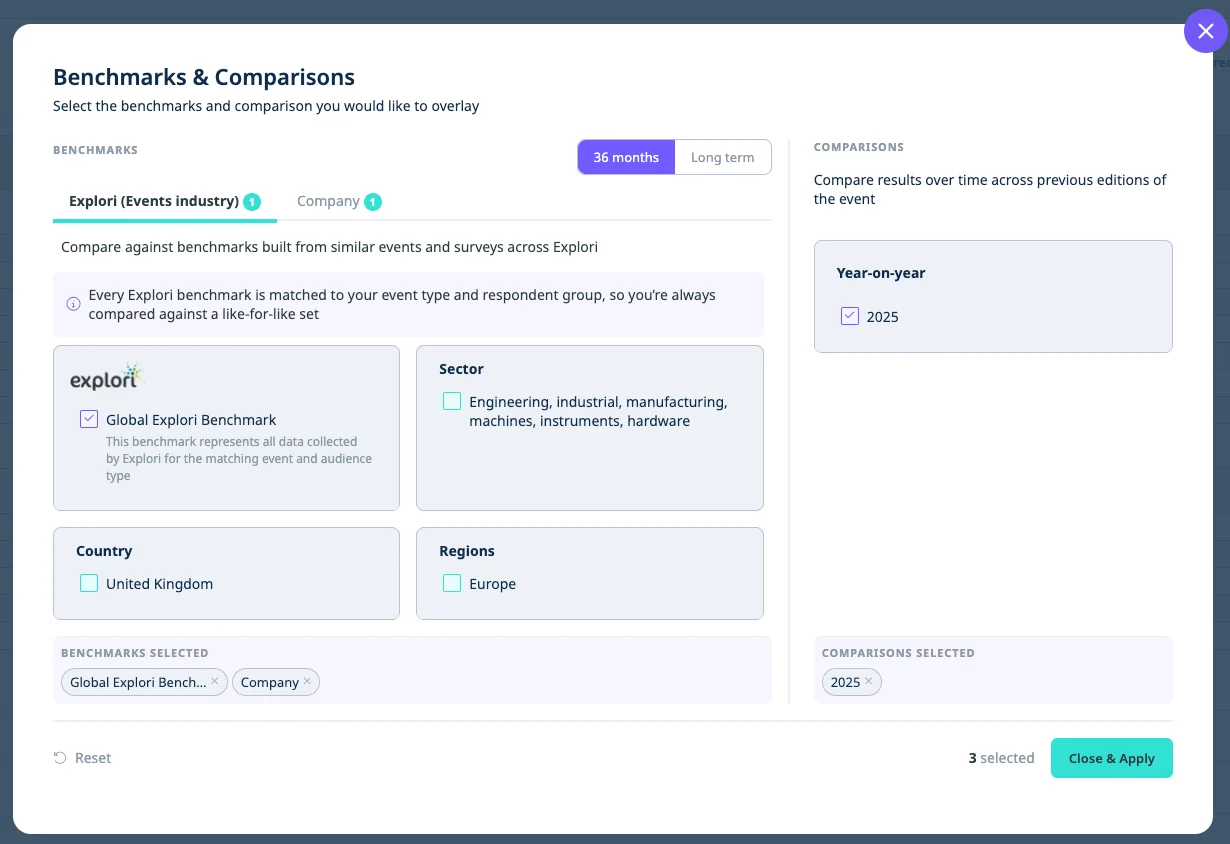
That is why Explori has expanded its benchmarking model to include country and regional benchmarks, alongside our flagship global benchmark.
Explori's benchmarking DNA
Explori's benchmarks are built on a rock solid foundation of consistent questions with four key pillars of event performance from an audience feedback perspective: overall satisfaction, likelihood to return, advocacy and perceived importance.
Across these core pillars, Explori has benchmarked over 3,000 events since 2023 and over 8,000 events since we started benchmarking in 2012. These events contribute to our rolling benchmark and all time benchmarking pool. This dataset is the foundation of the platform's benchmarking capability, and has enabled us to publish robust global benchmarks for Trade Shows, Conferences and consumer events for attendee and exhibitor audiences.
This foundation we have built over a number of years has now opened the opportunity to expand our benchmark offering to drill into specific subsets of our global benchmarks. And we have continued this expansion journey through geographical cohorts.
What's new
Explori now supports two additional benchmark types:
Country benchmarks
A country benchmark compares your event against a peer set in the same country as your venue. This is the closest "like-for-like" context when local market dynamics matter.
- United Kingdom
- United States
- United Arab of Emirates
- Italy
Regional benchmarks
A regional benchmark compares your event against a peer set across a culturally aligned region. This is designed for cases where country level is either too narrow or where you want a broader view that still reflects the market environment your event is operating within.
- Europe
- North America
- Asia Pacific
- Middle East and North Africa
Why availability varies (and why that's a good thing)
Benchmarks are only useful if they're credible. New benchmarks will only appear in platform when the underlying dataset is robust enough to publish.
Country and regional benchmarks are published only when there is sufficient data volume to ensure robustness. This includes safeguards designed to prevent the ability to dissect the benchmark pool and infer performance from a single event or organiser.
That means you will not see every country or every region in every scenario. When a country or regional slice doesn't meet publishing rules, rather than showing a comparison that looks precise but isn't reliable, Explori can still provide our Global Explori Benchmark, your year-on-year view and internal benchmarks.
What this enables
For event teams managing a portfolio across multiple geographies, regional benchmarks make it possible to evaluate each event against an appropriate local norm rather than forcing every event to compete against the same global benchmark.
A portfolio of trade shows operating across Europe, the Middle East, and Asia can now be assessed on a like-for-like basis within each region, while still being comparable at the portfolio level through Explori's consistent measurement methodology.
For organisations entering a new geography, regional benchmarks provide the baseline intelligence needed to set realistic targets, understand local audience expectations, and identify what levels of satisfaction and engagement represent genuine competitive performance in that market.
For boards and senior stakeholders, regional context makes event performance data considerably more defensible. A score that sits in the top quartile of its regional peer group is a more precise and credible statement than a score that sits somewhere in a global range.
The Global Explori Benchmark is the baseline
If you take one thing from this update, it should be this: the Global Explori Benchmark is still the default baseline.
It draws from the broadest pool in the dataset, which is why it stays reliable across a wide range of event formats, audiences and more niche contexts where country or regional cuts might be too thin.
Country and regional benchmarks do not replace the global benchmark. They complement it when the data supports it.
Why multiple benchmarks are better than a single comparison point
A common benchmarking trap is choosing one benchmark and treating it as the answer. In reality, benchmarking works best as a stack:
- Start with the Global Explori Benchmark for a robust baseline.
- Add a regional benchmark when you need market context.
- Add a country benchmark when local competitive reality matters.
- Use year-on-year to interpret your own change over time.
Those comparisons answer different questions. Used together, they make performance easier to explain, easier to defend and easier to act on.
Introducing the Global Explori Benchmark (previously labelled "Industry Benchmark")
You may have previously seen our flagship benchmark labelled as the "industry". We are officially renaming it to the Global Explori Benchmark.
This is not a change to the benchmark itself. It's a clarity fix. In practice, "industry" was ambiguous in its phrasing and didn't clearly define the true reference point.
The Global Explori Benchmark is our flagship global reference point, filtered by event type and respondent type. It is designed to be the benchmark you can rely on in the widest range of scenarios.
How to access regional benchmarks
Our Global, regional and country benchmarks are available within the Explori platform. These new benchmarks have been released alongside a fresh and practical UI to select the most available and relevant benchmarks and comparisons to display on your Report, Dashboards or via Data Explorer.
Want to see this in action on your own event data?
A 20-minute walkthrough on the platform — tailored to your event portfolio, your stakeholders, and the questions your executives keep asking.