
Incentive travel is trusted to deliver. Very few can prove it.
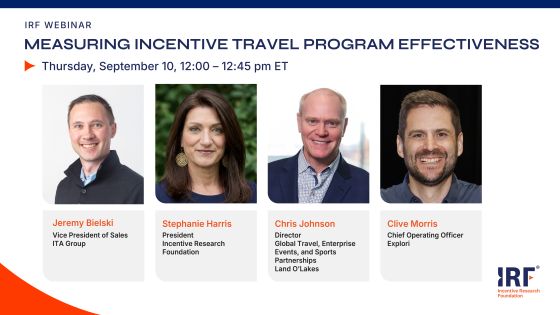
At the September Incentive Research Foundation webinar, Clive Morris, Chief Operating Officer of Explori, presented findings from new IRF research into how organisations measure the impact of incentive travel. Explori conducted the study as the IRF's independent research agency, surveying 114 programme owners and third-party providers between February and March 2026 and following up with eight in-depth interviews. Maritz was the research advocacy partner.
Clive was joined by Jeremy Bielski, Vice President of Sales at ITA Group, and Chris Johnson, who leads global travel, enterprise events and sports partnerships at Land O'Lakes. Together they tested the data against real programme experience.
The headline finding is a contradiction. Organisations believe their incentive programmes deliver against serious business objectives, yet very few are confident they can prove it.
Serious objectives and strong belief
Incentive travel is expected to move significant commercial outcomes. 68% of programme owners set sales revenue growth as an objective, and over half aim to improve engagement or retention.
Belief in delivery is high. 80% rated their programmes' impact against those objectives as good or excellent, and nobody rated it poor. Executive leadership assesses programme value in 84% of cases, and in 87% of those cases programme owners said executives value the programmes highly.
The first crack appears in finance
Finance and procurement are involved in assessment in 16% of cases. These teams often control the budget, yet only a third of programme owners in that group said finance and procurement highly value the programme.
"This is really the first moment in the research where we do start to see the cracks appearing," Clive said.
Only 4% are very confident
When asked whether their measurement approach accurately isolates what the programme does for the business, just 4% of programme owners were very confident. This increases to 36% when the proportion who answered fairly confident are added; however more than a quarter were not very confident or not confident at all.
The research points to two causes. The first is that the metrics in use do not match the objectives. 62% track participant satisfaction, while fewer than one in four track ROI or cost-benefit analysis. The second is that over half of measurement is informal: a short survey here and a data point there, with no structured plan behind it.
"Is it any surprise then that the confidence isn't there?" Clive asked.
Where do I even start?
48% of programme owners said they are not sure how best to measure outcomes, making it the most common barrier in the research. Where there was a view on how to measure, differences of opinion, limited time, budget and technology got in the way.
Chris added a useful nuance from Land O'Lakes. Qualification rules and sales performance are tracked closely by the business and by finance. The events team owns measurement of programme delivery. "Many of us don't actually own the measurement of the criteria," he said. The implication for programme owners is that some of the evidence they need may already exist elsewhere in the organisation.
Impact takes months while reporting is due in weeks
56% of programme owners report results within a week or a month of the programme. Only 8% expect to see measurable impact in that window. Nearly half expect impact to take between one month and more than a year to show, and one in five do not measure impact over time at all.
Programme owners are being held to a reporting window that is shorter than the impact they are trying to measure.
Jeremy described how some organisations are responding. They adopt a 100-day post-programme window to track meetings, pipeline activity and deal size among earners, and treat the programme as a year-round asset that extends well beyond the week on site.
What programme owners are asking for
Asked what would help, 46% of programme owners wanted a measurement framework or best-practice guidelines, the most requested support in the research. Clive highlighted two areas that are often missed: the behavioural impact of a programme and its attitudinal impact. These measure what changed in how participants act and what they believe.
Benchmarking came second, requested by 39%. "This might look good, but is it good?" Clive asked. Without comparable data, even strong results are hard to defend.
Clarity from leadership also matters. Clive described interviewees who asked several senior leaders about KPIs and got a different answer from each. One organisation reported running 12 systems that don't integrate, which they said made consolidated reporting impossible.
Third parties want to do more
Third-party agencies were twice as likely as in-house owners to report on ROI or cost-benefit analysis (46% against 23%). Many are held back by the client side: 44% cite restrictions on access to client data and 35% say there are no agreed KPIs to measure against.
Jeremy said the industry has relied too heavily on instinct. "For far too long on the meetings side, measurement's been done by vibes," he said. Analytics disciplines from loyalty and recognition programmes are now being applied to meetings and events.

For far too long on the meetings side, measurement's been done by vibes.
What we saw running the research
Conducting the study gave us a view of the data beyond the headline findings. Two points stand out for anyone responsible for an incentive travel budget.
The first is the size of what is at stake. Programme owners reported a median annual spend of around $3.8 million on incentive travel, and one in four spend more than $10 million. Most expect budgets to hold or grow over the next two years. At that level of investment, a satisfaction score is unlikely to carry the budget conversation for long, particularly when leadership changes. As the report notes, new executives who have not seen a programme first-hand may be more sceptical of its value.
The second is method. Only 23% of programme owners compare outcomes between people who took part in a programme and people who did not, and just 9% track participants over time.
Comparing participants with non-participants is what isolates the impact a programme created. Organisations running six or more incentive programmes were far more likely to adopt this approach (39% against 4%) and also more likely to measure against structured KPIs (50% against 29%). One respondent described working with their customer experience team and finding that agents who had earned a trip over a three-year period scored 30 points higher on customer satisfaction than agents who had not. That is the kind of evidence Finance, and every other senior stakeholder, can work with.
What this means for programme owners
The report closes with best-practice recommendations from the IRF and Explori. Combined with the panel's experience, they point to four practical steps:
- Start KPIs with the change you want in participants. Define what you want earners to believe and do differently as a result of the programme, then set the commercial outcomes those shifts should drive.
- Plan measurement before the programme runs. Decide how and when each KPI will be measured, and separate early indicators you can report within the required window from outcomes tracked over the following months.
- Bring finance and data owners in early. Map who needs to see programme impact and what they need, and agree data access upfront, including with third-party partners. Both panellists described the value of finance leaders joining programmes as hosts.
- Use consistent metrics across programmes. Comparable measures show what good looks like over time and between programmes, which is where benchmarking becomes useful.
Organisations that close this gap will be able to govern incentive investment with evidence that leadership and finance can compare and trust.
Watch the full webinar on demand.
Show leadership what your incentive programmes deliver.
Explori measures the shifts in attitude and behaviour your programmes create, with comparable data you can track across programmes and over time.